Like the color it purports to name, the social label black absorbs, integrates, and obscures distinct but interrelated phenomena: a skin tone of context-dependent shade, a racial classification from bygone times, an ethnic designation, a class marker, an immigration status, an ancestry, a cultural heritage, and an index of historical wrongs still fresh in memory. Black has often served as shorthand for of African descent, but perhaps nowhere most complicates that substitution than a region on the continent itself: North Africa. Continue reading Citations: Black in North Africa→
One of the few truly global holidays, International Workers’ Day (May Day) is both a worldwide celebration of the working classes as well as a day to draw attention to ongoing insecurities workers around the world face. May Day has historically had a twofold purpose: a day for workers to voice their concerns over contentious labor policies and for governments to reaffirm their commitments to workers’ rights and just labor practices. At times little more than public relations campaigns and at others violent clashes between governments and workers, global May Day events have highlighted the diverse relationships between labor, employers, and government around the world. Here are the highlights of May Day 2016 in more than 30 countries:
Asia Pacific
Bike rallies were held in Pune as Indian PM Narendra Modi saluted workers on Antarrashtriya Shramik Diwas, a public holiday. Pakistan‘s major labor unions convened in Lahore to speak out against poor working conditions, violations of international labor conventions, and ongoing privatization in the country. As Bangladeshi officials addressed labor relations and welfare reforms amidst a day of union-organized programming, in Kathmandu, Nepali workers marched while awaiting the ratification of the Labour Act, which guarantees greater social security for workers. Across the Indian Ocean, Australian union leader singled out penalty rate protection and tax reform as major Labour Day issues, with the date of the holiday having been a point of contention as well.
In cities across France, tens of thousands marched in protest against proposed labor reforms that would loosen the country’s controversial employment and job security policies. Jeremy Corbyn became the first U.K. Labour party leader to attend a May Day rally in a half-century when he spoke to a crowd of thousands in London, reaffirming solidarity against anti-immigrant sentiment and addressing anti-Semitism accusations that have plagued his party recently. Spain saw thousands across its cities gather, many protesting ongoing austerity measures. An estimated 800,000 gathered in Rome‘s San Giovanni Square, with this year’s event dedicated to slain Italian student Giulio Regeni.
Some 2,000 convened in rain-soaked Zagreb to hear labor leaders protest the increased retirement age and ongoing poverty in Croatia. Moscow hosted a mass demonstration in the city’s Red Square estimated in size from the tens of thousands to 100,000, while thousands gathered in Istanbul’s Bakirköy district under a heavy police presence in the wake of urban suicide attacks and ongoing violence across Turkey.
The Americas
From New York to Los Angeles, demonstrations in the U.S. highlighted widening economic inequality in the country and an election season marred by racist, xenophobic, and Islamophobic sentiment. While most protests took place without incident, a peaceful march turned violent in Seattle, leading to five injured officers and nine arrests. A similar outbreak in Montreal led to one injury and 10 arrests.
In Latin America, Brazil‘s embattled president and Workers’ Party leader Dilma Roussef rallied alongside hundreds of thousands across the country as her impeachment proceedings continue and workers fear the inauguration of her center-right vice president. Cuba‘s May Day parade continued the national tradition of expressing support for the Castro regime rather than directly celebrating labor or expressing concerns over labor conditions. In Argentina, President Mauricio Macro backed employers and touted labor proposals that had spurred mass demonstrations only days before. Elsewhere in the region, minimum wage increases were announced in Venezuela and Bolivia and a march took place in Santiago as Chilean President Michelle Bachelet announced a review of her labor reforms after the Supreme Court rejected a key provision granting exclusive negotiating rights to unions.
Middle East & Africa
Police in Egyptblocked hundreds of workers from assembling in a Cairo office as labor leaders and international organizations called for the government to decriminalize independent union organization. In Israel, more than 5,000 youth marched in Tel Aviv, while a Palestinian trade union renewed its call for the establishment of a minimum wage and the dismantlement of the Gaza blockade. A government-sponsored event in Dubai reportedly drew nearly 200 workers, though labor practices in the UAE continue to draw international scrutiny.
South of the Sahara, events popped up across South Africa as politicians sought to address the country’s high unemployment rate and appeal to workers ahead of August elections. In Nigeria, President Mohammadu Buhari spoke to thousands of workers in Abuja, touting his anti-corruption campaign. A Mozambique labor leader addressed a crowd in Maputo about the debts of state-owned companies and the need for wage and workplace reform. As the decline of oil prices has created economic hardship throughout Angola, the country’s two labor unions marched to draw attention to deteriorating worker conditions and the need for infrastructure maintenance. Workers in Ghana protested the privatization of the management of the state-owned Electric Company of Ghana, while the government insisted the company was still run by the state. Meanwhile, Ethiopia sidestepped Sunday commemorations altogether by moving May Day to May 3, when labor leaders plan to highlight ongoing struggles to organize Ethiopian workers.
Suspicion of land privatization policies erupts into rare protests across Kazakhstan
Despite the Kazakhstani government’s low tolerance for dissent, thousands rallied across the cities of Aqtobe, Semei, and Atyrau to protest proposed land privatization policies that will put 1.7 million hectares of public land up for auction beginning on July 1.
Kazakhstanis have expressed concern that land will be sold to foreigners (particularly the Chinese) or will end up in the hands of the elite, inflected by centuries of redrawn borders that have seen ethnic Kazakhs divided between Kazakhstan, Russia, and China.
Government officials have stated that the legislation only extends the foreign lease period cap from 10 to 25 years foreigners and have threatened to punish those who say otherwise.
Peruvian Máxima Acuña de Chaupe may have seemed like an unlikely agent for the deterrence of a major international company’s mining project, but the 47-year-old farmer and mother of four was able to halt U.S.-based Newmont and Peru-based Buenaventura’s joint development of a mine on her 60-acre farm with the help of social media and international organizations. Despite physical violence, arson, lawsuits, and fines, Acuña fought to stop the expropriation of her land and stave off eviction attempts that began back in 2011. A recipient of the 2016 Goldman Environmental Prize, Acuña has brought global attention to ongoing rights battles as private development encroaches upon territory small, often poor farmers depend on for their livelihoods. The Guardian and El País have profiled Acuña and the centrality of international solidarity in efforts to protect land and environmental rights.
“No sé si la situación se calmará, voy a seguir defendiendo mi tierra, tengo fe y seguiré pidiendo justicia.”
Translation: “I don’t know if the situation will calm down, I’m going to keep defending my land, I have faith and will continue demanding justice.”
Increasing violence plagues Brazilian land rights activists
After 50 died in 2015, at least six activists were killed in the first two months of 2016 as land rights groups report increased intimidation, criminalization, and violence committed against them.
Activists have sought reform to protect the at times conflicting land rights of small farmers and indigenous communities, particularly in rural states.
Brazil has some of the highest land-proprietary inequality in the world, with 1% of the population owning nearly 50% of the land and single families subject to payments from as many as tens of thousands of property owners thanks to a colonial-era law.
Thousands from Argentina’s main unions protest economic policies in Buenos Aires
Demonstrators took to the streets to protest currency devaluation, inflation, and massive layoffs stemming from new President Mauricio Macri’s economic policies.
Union leaders delivered speeches accusing the government of shifting the burden of economic stabilization onto workers and demanding measures to protect job security.
The mass demonstration took place ahead of International Workers’ Day, with leaders threatening to strike if the government ignored their concerns.
Widening socioeconomic divergence in the U.S. has taken center stage in the 2016 presidential campaigns, with everything from campaign financing to banking practices under scrutiny as progressive candidates challenge growing wealth inequality. But economic analysts have noted how beyond governance, socioeconomic divisions are increasingly becoming codified through atomized marketing and service provision practices. In business, product innovation has increasingly targeted the wealthiest Americans, creating both exclusive-service clubs and an aspirational marketing pipeline that some analysts say has fueled resentment.
Travel has been a particularly stratified industry: cruise lines maintain rigid hierarchies of accommodations and leisure facilities, while distinct class systems on airliners provide wildly different flying experiences for travelers. Talking points from luxury executives make clear that money is not the only bottom line: those of lower income willing to take the financial hit find their entry attempts circumvented by corporate policies that maintain a carefully curated elite. The New York Times examines how widening inequality is impacting innovation, service, and mobility in the U.S.
Healthcare in Kenya has struggled to reach the portion of the country’s population afflicted with mental illness, particularly those in rural communities. With around one psychiatrist for every 500,000 people in the country, families struggle to find professional support services, and services that do exist are overtaxed and underresourced. Rather than seek medical help, religiously devout communities often turn to faith healers to treat what are commonly accepted as spiritual rather than medical diseases.
People with mental illness find their conditions compounded by poverty and diseases that go unidentified and untreated, facing significant HIV infection rates and vulnerability. Recent efforts by Kenya-based mental health advocacy organizations and foreign investments in the country’s mental health services have created hope for broader treatment and enfranchisement of the community in Kenya, which, like many developing countries, shoulders some of the highest mental health burdens in the world.
Scotland works to correct massive land ownership inequality through pro-community initiatives
The Land Reform Bill of 2015 promotes community ownership and settlement in Scotland’s rural regions, establishing a new land registry and the Scottish Land Fund to help community groups purchase land.
A 2014 government report found that half of Scotland’s privately held land is owned by 0.008% of the population.
Scotland’s land inequality has been driven by aristocratic inheritance, violent land hoarding in the 1800s, and massive contemporary real estate investments by the wealthy.
India PM launches entrepreneurship initiative for members of historically disadvantaged communities
PM Narendra Modi announced Stand Up India, a program to spur entrepreneurship and business-technological integration among women and India’s Scheduled Castes and Scheduled Tribes, historically disadvantaged groups subject to affirmative action by the government.
Banks will be required to sponsor relatively inexpensive loans for entrepreneurs from disadvantaged and underrepresented communities.
The initiative comes ahead of next year’s elections in the state of Uttar Pradesh, with the Modi-led National Democratic Alliance (NDA) coalition seeking to court Dalit and tribal votes.
South Korean sex workers protest court ruling upholding criminalization of sex work
Pro-sex work activists protested the Constitutional Court’s decision to uphold a 2004 law that set punishments for both sex workers and customers, arguing it unfairly limits women’s economic opportunity and punishes poor clientele while paid relationships among the wealthy persist.
Sex workers and consumers face up to a year in jail or a fine of 3 million won ($2,600).
Activists say the ruling violates their right to work and announced intentions to petition the United Nations.
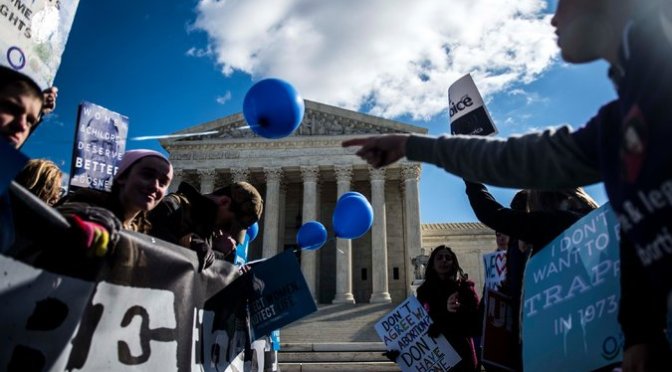
FDA eases restrictions around abortion pill, increasing access for rural and low-income women
The U.S. Food and Drug Administration now allows for mifepristone (Mifeprex) to be legally prescribed and taken further into pregnancy (10 vs. 7 weeks), with reduced dosage (200 vs. 600 mg), and requiring only two rather than three doctor’s visits.
Medical professionals and researchers have held that the restrictions, based on science from the 1990s, were out of step with advanced medical and pharmacological understanding.
Conservative states have long restricted access to mifepristone, requiring the drug to be administered by licensed physicians and at times in the presence of the prescribing doctor.
As cases of Zika infection and newborn microcephaly have exploded in heavily Catholic and evangelical Brazil, the country’s tough abortion laws—preventing the procedure except in cases of rape, maternal health endangerment, and child inviability—have come back into the international spotlight. Legislators have proposed the possible prison sentence for women who undergo an abortion from one to three years to four-and-a-half for women who abort because of detected microcephaly, with doctors facing up to 15 years. Brazil’s class divide has exacerbated healthcare restrictions, constraining women of less means to life-threatening procedures (including black market pills, Internet-advised intervention, acid injections, and self-attempted extraction) while wealthy women enjoy access to overseas healthcare and hidden networks of clinics and doctors. Vocativ takes a look at the dire straits Brazilian women seeking an abortion find themselves in and attempts to gain reproductive rights.
Brazil sheds 43% of child workers over last decade
Brazil’s number of child workers decreased to 2.8 million in 2014 from 5 million in 2004.
The demographics of child workers also shifted from predominantly uneducated children from low-income families to teenagers from economically stable families.
The Brazilian constitution bans children under the age of 13 from working, while youth aged 14 and 15 can work under apprenticeship programs and those aged 16 and older can have formal day jobs.
As Cuba’s economy continues to experience a significant boost from normalized relations with the U.S., many black Cubans and women have yet to see the benefits. Structural inequality and ongoing discrimination have shuttled the disadvantaged into an underclass of limited opportunity despite persistent and high-profile government attempts to eradicate the problem. While a significant number of white Cubans were able to flee abroad to the U.S. and send remittances back to their families, many Afro-Cubans were tied to what opportunity they could get in low-paying government jobs. Women have found themselves disproportionately shouldering domestic tasks, disappearing jobs, and lack of social capital relative to men. Boston Review, The Root, and the Thomson Reuters Foundation examine how political, social, and economic developments have re-marginalized Cuba’s black minority and women over the last two decades.
“Prejudice never disappeared. It was simply concealed under the table. And silence allowed all the problems to grow, under the table.”





 Outlas