Gang rape of 16-year-old sparks protests in Brazil
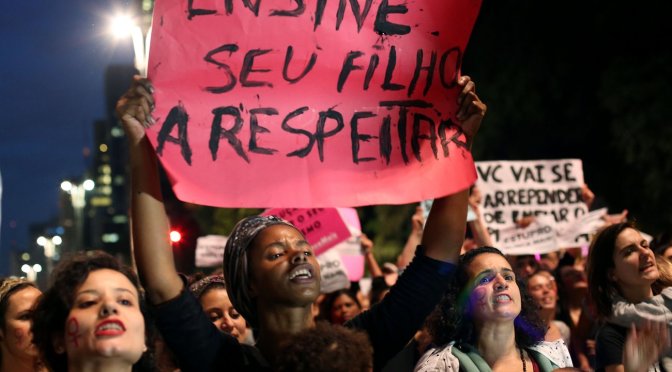
The case garnered international attention when a video went up on Twitter showing more than 30 men participating in the rape of the girl, apparently unconscious, in a Rio favela.
The crime was exacerbated by a slow, victim-antagonistic police response and a flood of misogynistic messages on social media.
Thousands marched in Rio de Janeiro and São Paulo in protest of high levels of gender-based violence in the country, with upwards of 10% of Brazilian women reporting cases of sexual violence along and a larger number of unreported cases.
Thousands protest violence against women in Buenos Aires
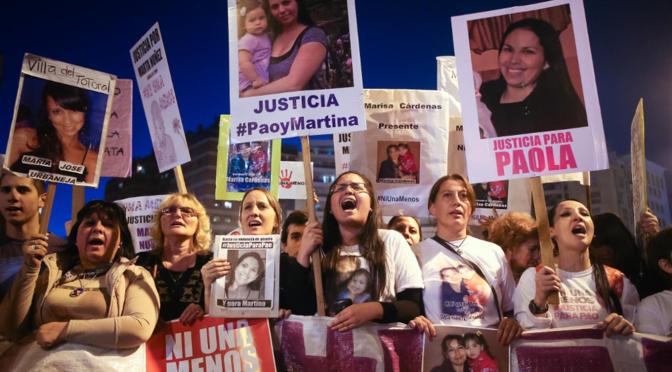
The #NiUnaMenos (“Not one less”) campaign brought thousands into the streets of the Argentinian capital to call attention to high levels of violence Argentine women of all ages have been subjected to.
The demonstration took place in the wake of the recent murders of three 12-year-old girls in separate incidents involving domestic as well as gang violence.
According to one report, 275 women have been killed in gender-based homicides in the year since the last public demonstration, including 165 from domestic violence and 40 involving women who had previously reported attacks by men.
Trans activist dies in northwest Pakistan after uproar over hospital treatment
Alisha, 23, died in a hospital in Peshawar after being shot multiple times during a dispute.
She had reportedly had her medical intervention delayed as hospital personnel taunted her and debated whether to put her in the male or female ward.
While police have taken in a suspect, the trans community continues to worry at ongoing targeted violence, with Alisha now the fifth trans activist to have been killed in recent months.
IS claims responsibility for murder of Bangladeshi Hindu and alleged Christian
Debesh Chandra Pramanik, 68, died after a hacking attack in his shoe shop in the northwest district of Gaibandha.
The attack followed the hacking death of a doctor in Kushtia Islamist militants alleged was a Christian.
The Islamic State claimed responsibility for the attacks, though the government continues to maintain that IS has no presence in Bangladesh and is attempting to hijack the work of other militant groups.
A YouGov/Action Aid UK survey recently polled 502 Indian women about their experiences in urban public spaces, finding that nearly four-in-five women have experienced public harassment in cities like New Delhi, Mumbai, Bangalore, Chennai, and Kolkata. In the aftermath of the brutal gang rape of a woman on a Delhi bus in late 2012, government and civil society campaigns have encouraged women to report violence, although advocates say crimes (particularly domestic violence) continue to be underreported.
79%
Percentage of women reporting having experienced public harassment in cities
46%
Percentage of women reporting public insults and name-calling
39%
Percentage of women reporting having been groped or touched involuntarily
16%
Percentage of women reporting having been drugged
337,922*
Number of reports of violence against women in 2014, including rape, abduction, and molestation
Crime report finds sharp uptick in anti-refugee attacks by far-right extremists in Germany
German Interior Minister Thomas de Maiziere reported a 35% increase in politically-motivated crimes by the far-right in 2015, the largest increase since the beginning of record-keeping in 2001.
More than 1,000 attacks on refugee shelters were reported, a more than five-fold increase over the previous year.
Overall, some 39,000 politically motivated crimes were reported in 2015, including a 31% increase in violent crimes.
Anti-Muslim protests in Myanmar increase following new government installation
Hundreds of Buddhist nationalists staged anti-Muslim protests ahead of a visit from U.S. Secretary of State John Kerry, who took up the issue of the persecution of Myanmar’s Muslim minority with state counselor Aung San Suu Kyi.
“No Muslims allowed” signs and anti-Muslim patrols have popped up in villages like Thaungtan, with those even suspected of being Muslim harassed and assaulted.
State counselor Aung San Suu Kyi reportedly instructed U.S. diplomats not to use the term “Rohingya,” echoing Buddhist nationalists who consider the Rohingya to be illegal immigrants and Muslims and Hindus “associate citizens.”
The International Day Against Homophobia, Transphobia & Biphobia
Commemorating the day when homosexuality was de-pathologized by the World Health Organization in 1990, the 13th-annual International Day Against Homophobia, Transphobia & Biphobia (IDAHOT) stands as an occasion for global mobilization towards LGBT visibility and security. The day, like many global celebrations, is also one many governments choose to speak out on global human rights and minority security, announcing initiatives to support their LGBT citizens and international projects.
Even today, ongoing disagreements between nations over LGBT rights have prompted diplomatic rows and roadblocks to international cooperation, including the recent objection of 51 Muslim countries to the participation of LGBT groups in a U.N. AIDS forum in June. The push to extinguish homophobia, transphobia, and biphobia at all geographic levels remains important to the global mobility of LGBT people worldwide.
LGBT Nigerians have continued wrestling with conflicting legal messages, with the recent passage of the landmark HIV Anti-Discrimination Act doing little to undo the effects of a 2014 anti-homosexuality law.
The Gay and Lesbians Association of Zimbabwe (GALZ) organized events for IDAHOT in Bulawayo, focusing on mental health as ongoing social and healthcare difficulties plague the community.
Though homosexuality remains criminalized in Tunisia, activists have achieved increased visibility and pushed for legal reform amidst ongoing discrimination.
Israel reaffirmed its commitment to LGBT Israelis, announcing funding to support an emergency shelter for LGBT youth and a hostel for trans people who have recently undergone gender confirmation surgery.
Days before IDAHOT, activists staged a sit-in outside of a Beirut gendarmerie, protesting Lebanon‘s anti-homosexuality legal holdovers from French occupation. Similarly, the Lebanese Medical Association for Sexual Health (LebMASH) issued an appeal to the Lebanese government to decriminalize same-sex relations, arguing for recognition of homosexuality’s presence within the natural variation of human sexuality.
U.S. President Barack Obama released a statement of support as his administration lended its voice to a national debate over the bathroom rights of trans people.
Across Latin America, important gains in same-sex partnership and family rights and gender identity healthcare and legal protections have heartened LGBT Latin Americans, but the region continues to have some of the highest reported rates of violence against the LGBT community in the world.
LGBT organizations held cultural and political events throughout Argentina to highlight conditions facing the Argentine LGBT community, call for an anti-discrimination law, and press for federal recognition of the International Day Against Sexual Orientation and Gender Identity Discrimination, as the day is known.
Cuba celebrated the day fresh off Pride events in Havana, where Mariela Castro, daughter of President Raúl Castro, led a parade of thousands through the city streets.
As the country continues contentious battles including the push for marriage equality and erasure of “gay panic” legal defenses, rainbow flags and celebrations appeared across Australia, including over police stations in Canberra, in the streets of Brisbane, and in the senior-care facilities of Tasmania. In Victoria, officials announced a retreat for Aboriginal gender minorities to be held later in the year.
In China, a study conducted by the U.N. Development Programme, Peking University, and the Beijing LGBT Center, the largest of its kind to date, was released revealing that only 5% of LGBTI Chinese are fully out at school and work, but also showed encouraging levels of acceptance of LGBTI people among China’s youth. The head of Hong Kong’s Equal Opportunities Commission expressed support for anti-discrimination legislation at IDAHOT festivities in the city.
In Fiji, former President Ratu Epeli Nailatikau joined festivities at the French Ambassador’s residence to celebrate the island’s LGBTQI community.
A tug-of-war over LGBT rights between Islamic fundamentalists and pro-diversity moderates in Indonesia has led to mixed messages about LGBT security in the nation, spurring anti-discrimination protests.
A recent Human Rights Watch report on anti-LGBT bullying in Japan served as a reminder of the purpose of the day, highlighting rampant anti-LGBT sentiment even as the government has initiated broad efforts to combat bullying in schools.
The divergent prospects for LGBTI people across Europe, from Western Europe’s distinctive commitment to the protection of gender diversity to ongoing persecution in the East, was further confirmed through a UNESCO report highlighting anti-LGBT violence in schools released as global education ministers met in Paris.
Rainbow colors appeared in the shopping district of Cyprus‘s capital as 22 organizations came together to organize events to launch the country’s third Pride Festival, focusing on the need to increase legal recognition of both sexual and gender minorities in the country.
In Gibraltar, organizers canceled event plans in support of action on marriage equality legislation currently under consideration, arguing that holding a rally in front of the Parliament as uncertainty prevails would undermine pressure on MPs.
Kosovo‘s first Pride march brought out hundreds from the LGBT community to Pristina, including the U.S. and U.K. ambassadors.
Organizations in Luxembourg planned a silent march to call attention to the plight of LGBTI individuals worldwide and call for increased international protections (including asylum).
Organizers in Serbia took the day to announce the date of this year’s Pride parade (September 18) and address concerns of homophobia as right-wing parliamentary representation has increased.
Advocates, allies, and diplomats gathered around the rainbow flag raised at the US Embassy in Latvia.
After advocates scrapped plans for IDAHOT activities in Georgia due to security concerns, a group of activists were arrested for painting pro-LGBT graffiti on administrative buildings. A “Family Day” protest against LGBT rights and visibility, the third such anti-LGBT demonstration, brought together members of Georgia’s conservative Orthodox community and international religious groups.
In the U.K., London’s new mayor promised to make the city a more just place for its LGBT residents as a rainbow flag flew over the Mayor’s Office.
The Hunted Albinism Community of East and Southern Africa
People with albinism, a condition affecting body pigmentation and sunlight sensitivity, have faced ongoing persecution throughout East and Southern Africa, attacked and trafficked by those who believe their body parts hold magical powers. With albinism found to occur more frequently in certain African regions like East Africa than elsewhere in the world, the higher visibility has led to increased discrimination and prejudice. Children in particular have faced heightened vulnerability to kidnapping and violence, leading some families and governments to respond by segregating children with albinism into Temporary Holding Centers (THCs).
Recent years have seen increased attention to the insecurity of the albinism community in countries like Mozambique, Malawi, and Tanzania. Police have worked to crack down on kidnapping and murders while civil organizations have cropped up to provide education, resources, and support to the community. Nevertheless, ongoing black markets and trafficking networks have endangered the community in ways observers worry may be irreversible without aggressive government and community interventions.
Militant arrested in connection to murder of LGBT activists in Bangladesh
Shariful Islam, also known as Shihab, was arrested in the district of Kushtia in connection with the deaths of Xulhaz Mannan and Mahbub Rabbi Tonoy.
Though Al Qaeda claimed responsibility for the murders, Dhaka police say Islam was affiliated with the banned local militant group Ansarullah Bangla Team.
Since 2013, only one in the series of killings of atheists, moderates, and foreigners in Bangladesh has been prosecuted.
Since the dawn of the new century, the role of international institutions and cooperation in efforts to promote gender equality has grown as economies, migration, and environmental conditions have continued intertwining peoples around the world. The Thomson Reuters Foundation recently interviewed Phumzile Mlambo-Ngcuka, the head of U.N. Women, about efforts to coordinate global efforts to promote women’s rights and security.
Ahead of the upcoming Women Deliver conference set to bring together 5,000 attendees from 150 countries, Mlambo-Ngcuka discussed the challenges of securing long-term investments in gender equality worldwide and the ambitious new agenda set through the new Sustainable Development Goals for 2030. The redress of structural inequalities, ongoing gender-based vulnerabilities, and the continued generational and gender outreach work necessary for equality continue to drive new programs in U.N. Women even as the work is met with derision or indifference from global political and business leaders.
ILGA-Europe recently released its annual report on the state of LGBT rights and security across the Europe. Covering developments in individual countries and transnational institutions from 2015, the report notes increasing legal protections for gender minorities and family and partnership rights for sexual minorities in Southern and Western Europe as well as ongoing political exclusion, persecution, and violence in Eastern Europe and Eurasia. Here are some of the highlights:
Malta
Rated the most progressive European country, Malta’s groundbreaking law prohibiting surgical intervention into a person’s sex characteristics without consent and inclusive education policies for trans, intersex, and other gender minorities were cited as distinctive policies.
Finland, France, Greece, Ireland
Other countries with significant judicial or policy victories regarding the rights of gender minorities.
Ireland, Luxembourg
Countries extending marriage rights to same-sex couples
Cyprus, Greece
Countries extending civil partnership rights to same-sex couples
Austria, Portugal
Countries extending adoption rights to same-sex couples
Caught in the orbit of Russia’s anti-LGBT political campaigns, Kyrgyzstan has seen increases in the persecution of its LGBT citizens as the former Soviet state’s realignment with Russia has led to the adoption of some of its most socially conservative policies. Much as in Russia, nationalism and anti-LGBT sentiment have gone hand in hand, with LGBT rights construed by reactionary nationalists as Western encroachment on Kyrgyz values and sovereignty. Amidst a floundering economy, anti-NGO and anti-LGBT bills have found significant support in Kyrgyzstan’s parliament, and though they have yet to be signed into law, police and citizens have used them as excuses to target the LGBT community and antagonize the few advocacy organizations that exist. Coda Story highlights Kyrgyzstan’s politicized homophobia and the stories of victims’ suffering under police extortion and indifference, sexual assault, and relentless threats.
Like the color it purports to name, the social label black absorbs, integrates, and obscures distinct but interrelated phenomena: a skin tone of context-dependent shade, a racial classification from bygone times, an ethnic designation, a class marker, an immigration status, an ancestry, a cultural heritage, and an index of historical wrongs still fresh in memory. Black has often served as shorthand for of African descent, but perhaps nowhere most complicates that substitution than a region on the continent itself: North Africa. Continue reading Citations: Black in North Africa→
Church seizures and political scapegoating heighten unease in Armenian-Turkish community
Turkey’s Armenian minority has found itself caught in the middle of increasing conflict between the Turkish government and Kurdish separatists, subject to intimidation, slurs, and attacks from politicians.
The Armenian-Turkish community has been particularly upset by the ongoing expropriation of historic churches through eminent domain seizures by the government.
In the wake of the centennial of the mass slaughter of Armenians in Turkey during World War I, the community has been fearful of hypernationalist discourse targeting Armenians.





 Outlas