Tag Archives: Europe

Citations | LGBTQ+ Asylum-seekers

Citations
Asylum Claims and the Adjudication of Sexual Identity

In immigration systems around the world, credibility stands as the primary burden of proof and identity indicator for sexual and gender minorities fleeing persecution in their countries of origin. In determining who assesses credibility and how, however, precision has long eluded researchers, lawmakers, and adjudicators as fluidity and multiplicity in identity has come to define sexual- and gender-minority communities. The reliance on expert assessments and interviewer perceptions in legal and administrative decisions has proven problematic from both a scientific and human rights perspective. Testing often involves a combination of physiological and psychological measurement, from arousal responses to personality assessments, and interviews have been based on a range of cultural biases and unrealistic expectations.

Immigration laws across nations have variously granted or denied asylum based on behavior, identity, affiliation, or perception, and the lack of standardization has created a large degree of uncertainty for LGBT individuals fleeing unsafe conditions in their countries of origin. This Citations installment outlines the patchwork of domestic and international laws and guidelines framing the consideration of asylum claims by sexual and gender minorities in popular destination countries, region- and country-specific legal and administrative processes, and recent trends in the assessment of sexual and gender identity and asylum claims.


Global

The U.N. Convention Relating to the Status of Refugees (also known as the 1951 Refugee Convention) established guidelines determining the status of an individual as a refugee, defined as “someone who is unable or unwilling to return to their country of origin owing to a well-founded fear of being persecuted for reasons of race, religion, nationality, membership of a particular social group, or political opinion.” The “membership of a particular social group” item has become the cornerstone of the expansion of asylum rights to LGBT individuals fleeing persecution, and international organizations have undertaken efforts to outline frameworks for ascertaining such membership.

European Union

In a victory for LGBT asylum-seekers in Europe, the E.U. Court of Justice recently ruled against Hungarian immigration officials’ decision to deny a gay Nigerian’s asylum claim as the result of a sexuality assessment test. In its ruling, the ECJ determined that while such psychological assessments are not prohibited, the results cannot factor into asylum decisions when testing methodology contravenes any of the human rights outlined in the Charter of Fundamental Rights of the European Union. The decision comes as the culmination of a series of rulings related to the assessment of sexual identity in asylum decisions in member states amid historic levels of trans-Mediterranean migration.

United States

Since 1994, the U.S. has recognized sexual identity as grounds for granting asylum in the country. The political and legal recognition of LGBT asylum-seekers has co-evolved with that of LGBT citizens, with asylum decision-making processes having liberalized alongside greater scientific research into sexual orientation and expanding legal rights and protections for LGBT citizens. Today, LGBT asylum-seekers submit an application that includes documentation corroborating both individual circumstances as well as the conditions LGBT individuals face in their country of origin and are then selected to participate in an interview with the Department of Homeland Security. With no government data kept regarding the outcome of claims based on sexual orientation, however, transparency and accountability have emerged as central issues for advocates and watchdogs seeking to promote security and rigor in adjudication.

Australia

While Australia has recognized sexual orientation as part of the 1951 Convention’s designation of “membership of a particular social group,” the country has faced significant criticism for its asylum process for LGBT petitioners, which has included low approval rates and offshore detention that has further imperiled asylum-seekers. When asylum-seekers have gone before the Refugee and Migration Division of the Administrative Appeals Tribunal in a final attempt to secure asylum, they have faced arbitrary, invasive, stereotypical, and culturally ignorant lines of questioning and expectations by interviewers and offered private photos and texts by asylum-seekers in desperation to “confirm” their sexual identity.

Canada

As immigration and refugee acceptance have become political hot topics in Europe, the U.S., and Australia, Canada has sought to position itself as a beacon of acceptance for individuals fleeing to the Global North to escape war or persecution. LGBT individuals petitioning for asylum enjoy higher-than-average approval rates in the country, but advocates have noted that Canada’s adjudication process has historically suffered from the same cultural biases and pitfalls in credibility assessment as other popular destination countries. Tight claim deadlines and multiple points of inquiry introduce further precarity in the process, but advocates are hopeful that a new set of guidelines issued in 2017 will improve the adjudication process. 

South Africa

A popular destination for LGBT Africans seeking refuge outside of their countries of origin, South Africa positioned itself as an early global leader in the establishment of LGBT legal rights and protections. Though the most progressive African nation in this respect, the country has nevertheless been criticized for the legal process through which it puts LGBT asylum-seekers, including reliance on temporary permits to defer long-term status provision and intimidation and credibility issues in the interview process.


Iceland News | Women

Gender pay parity law comes into effect in Iceland
  • Companies and public agencies with at least 25 employees will be required to obtain government certification of equal-pay practices or face fines.
  • Iceland became the first country to mandate pay equality by legislation in 2017, with the law now in effect with the arrival of the new year.
  • Since 2006, Iceland has closed 10% of its pay gap—one of the fastest improvement rates in the world—and pledged to eradicate it by 2020.
Read

In Iceland, it’s now illegal to pay men more than women” (Al Jazeera | January 2018)

Iceland first nation to make pay equality a legal requirement” (The New Zealand Herald | January 2018)

Iceland set to tackle gender pay gap with world’s toughest law” (BBC News | March 2017)

Study

The Global Gender Gap Report 2017 (World Economic Forum)

France News | Muslim Men

French hospital dismisses Egyptian trainee doctor from program for beard
  • The administrative court of appeals ruled in favor of the hospital after the surgery trainee sued as the result of termination by hospital managers at a Saint-Denis hospital for failing to trim his beard.
  • The trainee’s lawyer argued that the termination was discriminatory as a similarly long beard worn by someone who wasn’t Egyptian and named “Mohamed” would likely not have been asked to prove it was not of religious orientation.
  • French law dictates that religious expression is forbidden in state institutions like public hospitals, including personal symbolic displays that could be construed as religiously motivated.
Read

Un médecin renvoyé pour une barbe trop longue, la justice donne raison à l’hôpital” (Agence France-Presse, via Libération | December 2017 – in French)

‘C’est une décision complètement discriminatoire’ : un médecin stagiaire renvoyé à cause d’une barbe trop longue” (franceinfo | December 2017 – in French)

French hospital rejects trainee doctor due to ‘religious’ beard” (The Telegraph | January 2018)


France News | People of Color

Discussions of systemic racism in France provoke backlash
  • Recent rows in French government and civil society have pitted anti-racism activists against government officials over discussions of the state and other political institutions’ role in propagating racial inequality.
  • Journalist Rokhaya Diallo was removed from France’s national digital council only a week after her appointment following a campaign by right-wing activists and officials that targeted her for, among other things, her discussions of “institutional racism.”
  • The same use of the term by the teachers union SUD-Education 93 led Education Minister Jean-Michel Blanquer to indicate he will pursue complaints against the organization as well as for having hosted workshops reserved for people of color.
Read

French race row erupts as feminist forced off advisory body” (The Guardian | December 2017)

Blanquer porte plainte contre un syndicat qui a utilisé l’expression «racisme d’Etat»” (Le Monde | November 2017, in French)

Les ateliers « en non-mixité raciale » du syndicat SUD-Education 93 créent une polémique” (Le Monde | November 2017, in French)

Additional

When will France admit that police racism is systemic?” (The Guardian | March 2017)


Austria News | Gay, Lesbian & Bisexual

Austria’s highest court recognizes same-sex marriage rights
  • The Constitutional Court of Austria ruled that the country’s law banning same-sex marriage was unconstitutional.
  • The law in question, introduced in 2009, allowed for registered partnerships but not full marriage for same-sex couples, creating discriminatory sex-based classes of partnership.
  • The decision paves the way for same-sex couples in Austria to begin marrying in 2019, becoming the 16th European country to recognize same-sex marriage rights.
Read

Austria’s supreme court paves way for same-sex marriage from 2019” (Reuters | December 2017)

Austrian Supreme Court rules in favour of same-sex marriage” (BBC News | December 2017)

Austrian court rules same-sex couples can marry from 2019” (CNN | December 2017)

Germany News | LGBT

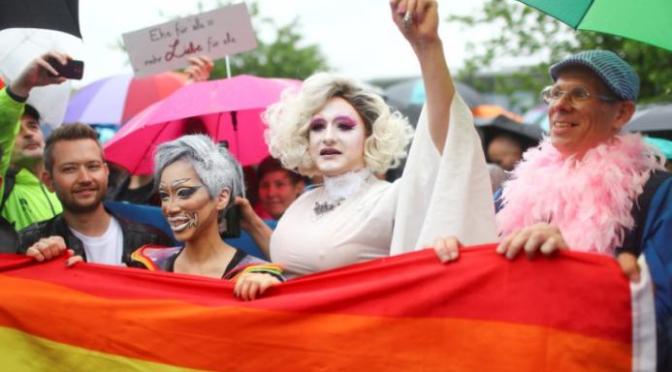
German parliament votes to legalize same-sex marriage
  • The lower house voted to ratify marriage equality 393-296-4 in a year that has seen Germany attempting to redress historical injustices against its LGBT community.
  • The vote followed Chancellor Angela Merkel’s softening of her party’s position and allowance of a conscience vote, permitting members of her party to break ranks and vote in favor of marriage equality.
  • The vote extends full marriage rights to LGBT citizens, including adoption rights.
Read

German lawmakers approve same-sex marriage in landmark vote” (Reuters | June 2017)

German Parliament Approves Same-Sex Marriage” (The New York Times | June 2017)

German parliament votes to legalise same-sex marriage” (The Guardian | June 2017)

(Image Credit: Hannibal Hanschke/Reuters)

U.K. News | Underrepresented Communities

U.K. elects most diverse parliament in history
  • 51 MPs of color (black and minority ethnic, or BME) were elected to the House of Commons, an increase of some 25% from the 41 elected in the previous election cycle.
  • 208 women were elected, an electoral record though still only 32% of Parliament, and more than 40 LGBT MPs now form the largest cohort of openly queer politicians in the history of the House of Commons.
  • The new parliament also features the first Palestinian, first female Sikh, four black female, first turban-wearing Sikh, and four openly disabled MPs.
Read

Election results: Record number of black, Asian and ethnic minority MPs elected to parliament” (The Independent | June 2017)

The New Parliament Has More Black, Asian, And Women MPs Than Ever Before” (BuzzFeed News | June 2017)

Election 2017: Record number of female MPs” (BBC News | June 2017)

(Image Credit: Facebook, via The Independent)

Ireland News | Gay Asian-Irish

Irish governing party elects first out gay, Indian-descendent PM
  • The Fine Gael voted Leo Varadkar its new leader, a gay, half-Indian man set to become the youngest PM in Irish history.
  • Varadkhar, 38, was born to an Indian immigrant father and an Irish mother and has become a polarizing conservative firebrand in Irish politics since his first election in 2007.
  • The election has been lauded as a monumental moment for the predominantly Catholic country that in 2015 became the first in the world to codify marriage equality into law through referendum.
Read

Varadkar becomes Irish PM-in-waiting in social, generational shift” (Reuters | June 2017)

Leo Varadkar wins: Ireland set to install first openly gay Prime Minister” (The Independent | June 2017)

From Enda (66) to Leo (38): Ireland set to replace oldest EU leader with youngest” (The Irish Times | June 2017)

(Image Credit: Clodagh Kilcoyne/Reuters)

France News | Black Women

Paris mayor backtracks after threatening to ban Afro-feminist festival
  • Mayor Anne Hidalgo originally threatened to prohibit the Nyansapo Festival, alert police, and sue for discrimination, repeating far-right accusations that the event was “prohibited to white people” despite no such language appearing in the organizers’ materials.
  • Festival organizers, part of the Mwasi Collective, planned to reserve certain events for black women, others for black people of all genders, others for women of color in general, and others still for the general populace in an attempt to provide open discussion spaces free of judgment for minority participants.
  • The mayor eventually backtracked, although she and right-wing activists claimed victory for having “established a solution” as a rest of Hidalgo’s “firm intervention.”
Read

Paris mayor vows to halt black feminist festival, then backtracks” (France 24 | May 2017)

Aux origines de la polémique sur le festival afroféministe Nyansapo” (Libérationin French | May 2017)

Comme au Nyansapo Fest, pourquoi certaines associations prônent la non-mixité” (Huffington Postin French | May 2017)

Visit

Festival Nyansapo

(Image Credit: via Libération)

Europe & Eurasia Research | Religious & Belief Minorities

Religion and National Identity in Eastern Europe and Eurasia

The Pew Research Center recently conducted a survey on the relationship between religious and national identity in Eastern European and Eurasian countries, noting changes in the way that religious identification has influenced national identity since the fall of atheist fundamentalism with the USSR. For religious and belief minorities—now including atheists—the relationship can be a troubling one, particularly as resurgent nationalism in the region has been accompanied by xenophobia and religious discrimination.

Here are highlights from the findings:

70% (Orthodox-majority) / 57% (Catholic-majority)

Average among countries who believe majority religious identity is very or somewhat important to national identity

82% (Armenia)
81% (Georgia)
78% (Serbia)
76% (Greece)
74% (Romania)
66% (Bulgaria)
63% (Moldova)
57% (Russia)
51% (Ukraine)
45% (Belarus)

Percentage within Orthodox-majority countries who believe Orthodox religious identity is very or somewhat important to national identity

64% (Poland)
58% (Croatia)
56% (Lithuania)
43% (Hungary)

Percentage within Catholic-majority countries who believe Catholic religious identity is very or somewhat important to national identity

Read

Religious Belief and National Belonging in Central and Eastern Europe (Pew Research Center | May 2017)

U.K. News | Muslims & Ethnic Minorities

Reported hate crimes double in Manchester in aftermath of bombing
  • Some 56 hate crimes were reported in the two days following the bombing in Manchester by a Briton of Libyan descent, a twofold increase over the 28 in the two previous days (the average amount, according to law enforcement).
  • Incidents included bomb threats, intimidation, slurs, and racist graffiti across the city.
  • Community members noted a significant number of incidents had gone unreported and expressed frustration at the expectation of apologizing on behalf of all Muslims while being subjected to anti-Muslim abuse.
Read

Manchester attack: Hate crime ‘doubles’ after incident” (BBC News | May 2017)

Muslim leaders in Manchester report rise in Islamophobic incidents” (The Guardian | May 2017)

Manchester sees rise in hate crimes after attack” (Al Jazeera | May 2017)

(Image Credit: Stefan Wermuth/Reuters, via The Guardian)

Italy News | Black

Italian MEP convicted of defamation for racist remarks
  • Mario Borghezio was convicted for comments against former Italian MP Cécile Kyenge, Italy’s first black national minister.
  • Borghezio had stated in a 2013 interview that Kyenge, who immigrated from the DRC, wanted to “impose her tribal traditions from the Congo” and was “a good housewife, but not a government minister.”
  • Kyenge has faced numerous racial attacks as a result of her political visibility, and the ruling is the latest in a series of successful defamation cases she has brought.
Read

Northern League MEP must pay €50,000 to ex-minister over racial slurs” (The Local | May 2017)

Italian in Europe’s Parliament Convicted of Defamation for Racial Insult” (The New York Times | May 2017)

Italian MEP Cecile Kyenge: ‘I feel vindicated’” (BBC News | May 2017)

(Image Credit: Gianni Cipriano/The New York Times)

Italy Feature | Women & Migrants

The Enduring Exploitation of Italy’s Grape Harvesters

Two years after the plight of its grape harvesters crashed into the global consciousness, Italy continues to struggle to uproot the labor practices that have been called “modern-day slavery” by human rights and labor rights advocates. Recent legislation has prioritized the eradication of exploitation, but underground organizations continue to take advantage of the dire conditions of Italy’s most vulnerable. Overworked, underpaid, and subject to extortion by recruiting and transportation agencies, the migrants and poor Italian women enduring the strenuous work of picking and cleaning grapes continue to struggle with difficult choices between precarious work, personal health, and acquiescence in a system designed for their failure.

Read

A Woman’s Death Sorting Grapes Exposes Italy’s ‘Slavery’” (The New York Times | April 2017)

Additional

Fire kills two in Italy migrant farm workers’ ‘ghetto’” (Reuters | March 2017)

(Image Credit: Nadia Shira Cohen/The New York Times)

France News | Migrants & Asylum-Seekers

Calais mayor bans gatherings at site of closed refugee camp
  • The ban will prohibit charity organizations from distributing food, clothing, and other survival resources to migrants and refugees attempting to travel to the United Kingdom from France.
  • Police have reportedly begun using teargas to break up attempts at food distribution at the site of the former camp, which was dismantled in October 2016.
  • Mayor Natacha Bouchart accused such gatherings of ratcheting ethnic tensions among migrants and endangering public safety.
Read

Calais mayor bans distribution of food to migrants” (The Guardian | March 2017)

Charities slam Calais ban that could halt food aid for migrants” (Reuters | March 2017)

Outcry after Calais mayor bans food handouts to migrants” (AFP via France24 | March 2017)

(Image Credit: Matt Dunham/AP, via The Guardian)

Morocco & Spain News | Migrants & Asylum-Seekers

Hundreds storm gate to Morocco-Spain border at Ceuta exclave
  • The autonomous Spanish enclave of Ceuta, one of only two land borders between Africa and Europe, saw some 850 sub-Saharan migrants and asylum-seekers scaling barbed wire fences along the five-mile border between Morocco and Spain to reach the immigration center inside.
  • The city, located on the northwest coast of Morocco, has long been the site of attempts to cross into Europe, although strong security forces have kept most attempts at bay.
  • The event follows a similar—though unsuccessful—one from New Year’s Day, when more than 1,000 attempted to breach the gate.
Read

Los saltos en la valla de Ceuta se duplican tras la amenaza de Marruecos” (El País | February 2017)

Morocco uses migrant crisis as leverage in EU free trade dispute” (France24 | February 2017)

Risking Injury and Arrest, African Migrants Storm a Gate to Europe” (The New York Times | February 2017)

(Image Credit: Jesus Moron/Associated Press, via The New York Times)