Tag Archives: Society

Pakistan Feature | Trans Women

The Fitful Progress of the Movement for Pakistani Trans Lives

Source: CGTN YouTube

By way of Pakistan’s landmark 2017 census, some 10,000 transgender Pakistanis have become officially visible in the eyes of the government, though community organizers say the number is likely much larger. Illiteracy, poverty, disenfranchisement, trafficking, threats to sexual health, and the dangers of unregulated sex work plague Pakistan’s trans women (khawaja siras, a reclaimed term in the trans community), but the recent securing of legal protections have given hope to a community where precarity reigns.

While communities of trans women have provided kinship and security where mainstream society has offered a mix of scorn and fetish, hierarchical systems within the communities have layered additional vulnerabilities upon threats already faced. The women have organized and built security-focused civil groups, and the last decade has seen a number of victories including census recognition, a third-gender option on ID cards, limited economic investments, and technological and political tools for accountability in law enforcement. Some hardline conservatives have become unlikely allies as trans women are seen among some Islamic sects as holy, though they have stopped short of supporting partnership rights. Recent international media coverage has highlighted recent gains as well as ongoing insecurity for Pakistan’s increasingly visible trans community.

Read

Pakistan’s Transgender Women, Long Marginalized, Mobilize For Rights” (NPR | January 2018)

Tabooed transgender community still facing discrimination but to be protected in Pakistan” (Xinhua | January 2018)

New App TransMuhafiz Puts Pakistani Transphobic Offenders in the Spotlight” (Planet Transgender | January 2018)

Watch

Transgenders: Pakistan’s Open Secret (Clover Filmsvia Real Stories/YouTube | December 2016)

Somebody (TriumF Mediavia YouTube | September 2017)

Connect

TransAction Pakistan

Singapore News | Gay Men

Singaporean gay man denied adoption rights for biological child
  • A Singapore court ruled against a man seeking to adopt his biological son mothered by a surrogate in the U.S.
  • The man, currently in a same-sex relationship, pursued international surrogacy due to his remote chances at adoption in Singapore, where male same-sex relations are still illegal.
  • Surrogacy is prohibited and in-vitro services available only to married couples in Singapore, leading many Singaporean couples both same- and different-sex couples to seek assisted reproduction services abroad.
Read

Singapore court rejects gay man’s bid to adopt biological son” (NBC News | December 2017)

More Singapore couples seeking surrogacy services” (The Straits Times | December 2017)

Gay Singaporean loses bid to adopt biological son fathered via surrogate” (Agence France-Presse, via AsiaOne | December 2017)

France News | Muslim Men

French hospital dismisses Egyptian trainee doctor from program for beard
  • The administrative court of appeals ruled in favor of the hospital after the surgery trainee sued as the result of termination by hospital managers at a Saint-Denis hospital for failing to trim his beard.
  • The trainee’s lawyer argued that the termination was discriminatory as a similarly long beard worn by someone who wasn’t Egyptian and named “Mohamed” would likely not have been asked to prove it was not of religious orientation.
  • French law dictates that religious expression is forbidden in state institutions like public hospitals, including personal symbolic displays that could be construed as religiously motivated.
Read

Un médecin renvoyé pour une barbe trop longue, la justice donne raison à l’hôpital” (Agence France-Presse, via Libération | December 2017 – in French)

‘C’est une décision complètement discriminatoire’ : un médecin stagiaire renvoyé à cause d’une barbe trop longue” (franceinfo | December 2017 – in French)

French hospital rejects trainee doctor due to ‘religious’ beard” (The Telegraph | January 2018)


France News | People of Color

Discussions of systemic racism in France provoke backlash
  • Recent rows in French government and civil society have pitted anti-racism activists against government officials over discussions of the state and other political institutions’ role in propagating racial inequality.
  • Journalist Rokhaya Diallo was removed from France’s national digital council only a week after her appointment following a campaign by right-wing activists and officials that targeted her for, among other things, her discussions of “institutional racism.”
  • The same use of the term by the teachers union SUD-Education 93 led Education Minister Jean-Michel Blanquer to indicate he will pursue complaints against the organization as well as for having hosted workshops reserved for people of color.
Read

French race row erupts as feminist forced off advisory body” (The Guardian | December 2017)

Blanquer porte plainte contre un syndicat qui a utilisé l’expression «racisme d’Etat»” (Le Monde | November 2017, in French)

Les ateliers « en non-mixité raciale » du syndicat SUD-Education 93 créent une polémique” (Le Monde | November 2017, in French)

Additional

When will France admit that police racism is systemic?” (The Guardian | March 2017)


Lebanon Feature | Syrian Refugees

The Administrative Precarity of Syrian Refugees in Lebanon

Syrians who have fled to Lebanon to escape the violence that has embroiled their home nation have begun putting down new roots while waiting for the conflict to end. However, cultural and administrative differences have left many Syrians in limbo as practices surrounding institutions like marriage remain unrecognized in their new, if temporary, home. Lebanon’s complex and financially taxing requirements of civil registration (including residency, marriage, and births) has disenfranchised many Syrians, leaving them in legally precarious situations even as the government works to lessen the burdens.

Undocumented children are denied access to IDs and passports, and parents and other couples lacking official work permits find themselves trapped in exploitative labor conditions to support their families. The financial vulnerability of Syrian families is driving intergenerational insecurity, particularly as it has led to an increase in child marriage rates in the country. Reuters examines the complex bureaucratic and cultural conditions shaping the marginalization of Syrian families in Lebanon.

Read

As Syrian couples say ‘I do,’ Lebanon says ‘No, not quite’” (Reuters | December 2017)

Additional

For Syrian refugees, child marriage robs a generation of its future” (The Globe and Mail | March 2017)


South Africa News | Poor & Working Class

South African president announces free higher education for poor and working-class students
  • The change affects students from households making up to 350,000 South African rand (~USD26,715) enrolled in the country’s TVET (Technical Vocational Educational and Training) colleges.
  • President Jacob Zuma has pledged to implement the shift from loan- to grant-based subsidies in a “fiscally responsible manner,” with aid to higher education institutions set to increase from 0.7% to 1% of GDP over the next five years.
  • Critics continued to question the financing for such a sweeping initiative, with the finance minister indicating details will be deferred to the 2018 budget unveiling in February.
Read

Zuma announces free higher education for poor and working class students” (News24 | December 2017)

Gigaba: How government will fund free education to be clarified at 2018 budget” (The Mail & Guardian | December 2017)

Zuma says South Africa’s free higher education to be done in a fiscally sustainable manner” (Reuters | December 2017)

Algeria News | Christian

Christians celebrate opening of Christmas market in Algiers
  • Catholic international organization Caritas organized the market, which has seen contributions from Christians and Muslims alike as a result of increased advertisement in its second year.
  • Algeria’s population is 99% Sunni Muslim but has seen an increase in its Christian minority as a result of the international diplomatic community and influx of sub-Saharan migrants from countries like Mali, Niger, and Burkina Faso.
  • Because proselytizing is legally forbidden, Algerian Christian organizations focus on social services in local communities as well as cultural exchange between the country’s Christian and Muslim communities.
Read

Christmas market opens in Algerian capital” (Reuters | December 2017)

« Chrétiens d’Algérie », ils témoignent sans prosélytisme” (La Croix | October 2017, in French)

Dans ‘Chrétiens d’Algérie-Sur les chemins de la rencontre’, Jean Dulon dévoile une ‘Algérie proche et fraternelle’” (The Huffington Post Maghreb | March 2017, in French)

Kyrgyzstan Feature | LGBT

The Expanding Insecurity of Kyrgyzstan’s LGBT Community

Bishkek, long viewed as a relatively liberal haven not only in Kyrgyzstan but within the largely conservative Central Asia region, has seen an increase in political and social hostility towards its LGBT community. As in other parts of Eurasia, Kyrgyzstan has witnessed a resurgence in far-right ultra-nationalism and an attendant conflation of LGBT rights with Western encroachment on Kyrgyz culture, leading to increased attacks on the Kyrgyz LGBT community. Similar to other Eurasian nations, legislation has been proposed to limit information access about the LGBT community, and the shuttering of Bishek’s last remaining gay club has left the LGBT Kyrgyzstanis with few opportunities for safe communal socializing.

Read

‘All of us will be victims at some point’: why Bishkek’s only gay club closed” (The Guardian | October 2017)

Curtain Falls On Bishkek’s Lone LGBT Club Amid Worsening Atmosphere” (Radio Free Europe/Radio Liberty | June 2017)

Connect

Labrys
Kyrgyz Indigo

U.K. News | Underrepresented Communities

U.K. elects most diverse parliament in history
  • 51 MPs of color (black and minority ethnic, or BME) were elected to the House of Commons, an increase of some 25% from the 41 elected in the previous election cycle.
  • 208 women were elected, an electoral record though still only 32% of Parliament, and more than 40 LGBT MPs now form the largest cohort of openly queer politicians in the history of the House of Commons.
  • The new parliament also features the first Palestinian, first female Sikh, four black female, first turban-wearing Sikh, and four openly disabled MPs.
Read

Election results: Record number of black, Asian and ethnic minority MPs elected to parliament” (The Independent | June 2017)

The New Parliament Has More Black, Asian, And Women MPs Than Ever Before” (BuzzFeed News | June 2017)

Election 2017: Record number of female MPs” (BBC News | June 2017)

(Image Credit: Facebook, via The Independent)

Ireland News | Gay Asian-Irish

Irish governing party elects first out gay, Indian-descendent PM
  • The Fine Gael voted Leo Varadkar its new leader, a gay, half-Indian man set to become the youngest PM in Irish history.
  • Varadkhar, 38, was born to an Indian immigrant father and an Irish mother and has become a polarizing conservative firebrand in Irish politics since his first election in 2007.
  • The election has been lauded as a monumental moment for the predominantly Catholic country that in 2015 became the first in the world to codify marriage equality into law through referendum.
Read

Varadkar becomes Irish PM-in-waiting in social, generational shift” (Reuters | June 2017)

Leo Varadkar wins: Ireland set to install first openly gay Prime Minister” (The Independent | June 2017)

From Enda (66) to Leo (38): Ireland set to replace oldest EU leader with youngest” (The Irish Times | June 2017)

(Image Credit: Clodagh Kilcoyne/Reuters)

France News | Black Women

Paris mayor backtracks after threatening to ban Afro-feminist festival
  • Mayor Anne Hidalgo originally threatened to prohibit the Nyansapo Festival, alert police, and sue for discrimination, repeating far-right accusations that the event was “prohibited to white people” despite no such language appearing in the organizers’ materials.
  • Festival organizers, part of the Mwasi Collective, planned to reserve certain events for black women, others for black people of all genders, others for women of color in general, and others still for the general populace in an attempt to provide open discussion spaces free of judgment for minority participants.
  • The mayor eventually backtracked, although she and right-wing activists claimed victory for having “established a solution” as a rest of Hidalgo’s “firm intervention.”
Read

Paris mayor vows to halt black feminist festival, then backtracks” (France 24 | May 2017)

Aux origines de la polémique sur le festival afroféministe Nyansapo” (Libérationin French | May 2017)

Comme au Nyansapo Fest, pourquoi certaines associations prônent la non-mixité” (Huffington Postin French | May 2017)

Visit

Festival Nyansapo

(Image Credit: via Libération)

Europe & Eurasia Research | Religious & Belief Minorities

Religion and National Identity in Eastern Europe and Eurasia

The Pew Research Center recently conducted a survey on the relationship between religious and national identity in Eastern European and Eurasian countries, noting changes in the way that religious identification has influenced national identity since the fall of atheist fundamentalism with the USSR. For religious and belief minorities—now including atheists—the relationship can be a troubling one, particularly as resurgent nationalism in the region has been accompanied by xenophobia and religious discrimination.

Here are highlights from the findings:

70% (Orthodox-majority) / 57% (Catholic-majority)

Average among countries who believe majority religious identity is very or somewhat important to national identity

82% (Armenia)
81% (Georgia)
78% (Serbia)
76% (Greece)
74% (Romania)
66% (Bulgaria)
63% (Moldova)
57% (Russia)
51% (Ukraine)
45% (Belarus)

Percentage within Orthodox-majority countries who believe Orthodox religious identity is very or somewhat important to national identity

64% (Poland)
58% (Croatia)
56% (Lithuania)
43% (Hungary)

Percentage within Catholic-majority countries who believe Catholic religious identity is very or somewhat important to national identity

Read

Religious Belief and National Belonging in Central and Eastern Europe (Pew Research Center | May 2017)

South Africa Feature | Low-Income & Working-Class Black

The Entrenched Legacy of Housing Segregation in Cape Town

Like many global metropolises, Cape Town faces conflicts over how to secure housing rights for low- and middle-income households inflected by histories of racist social engineering. Cape Town’s situation is complicated by the legacy of housing apartheid in South Africa, which continues to render historically white-only neighborhoods financially inaccessible for many black households and threatens to uproot others as the high tide of gentrification approaches. A number of media outlets have recently examined the persistence of housing segregation in the city and political and guerrilla efforts to promote inclusive urban planning and secure affordable housing rights for black Capetonians.

Read

‘End spatial apartheid’: why housing activists are occupying Cape Town” (The Guardian | May 2017)

Profile: How gentrification is creating a new apartheid in South Africa” (The National | May 2017)

We must end Cape Town’s housing ‘apartheid’ – think-tank” (The Thomson Reuters Foundation | May 2017)

(Image Credit: Ashraf Hendricks/GroundUp, via The Guardian)

Uganda News | South Sudanese Refugees

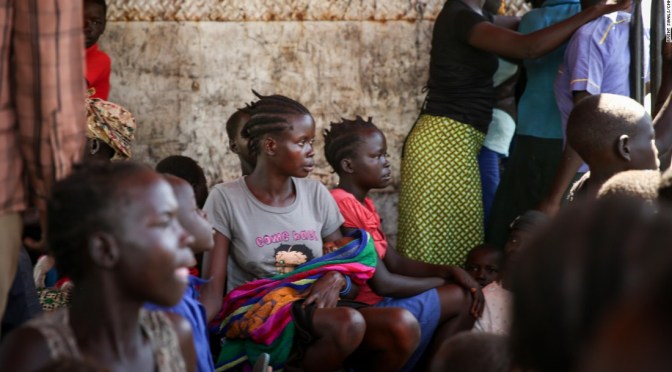
U.N. food cuts lead to desperate food situation for refugees in Uganda
  • The U.N. cut food rations by half in refugee camps, adding to an already critical famine driving displacement in the region.
  • Refugees have taken to stealing crops and other food from locals to sustain themselves, and while no widespread violence has broken out yet, tensions have worn at the historically amicable relations between Ugandans and refugees.
  • Nearly 1 million refugees have fled from South Sudan into neighboring Uganda, a significant fraction of the 3 million driven from the country since the outbreak of civil war in 2013.
Read

South Sudan refugees scrounge for scraps as rations slashed in Uganda camps” (Reuters | May 2017)

Tensions rise as Uganda neighbourly refugee policy starts to feel the strain” (The Guardian | May 2017)

Faced with slaughter they fled, now their safe haven teeters on the brink” (CNN | May 2017)

(Image Credit: via CNN)

Australia Feature | Mixed-race Aboriginal

Australia’s “Stolen Generation” Speaks

For six decades across the 20th century, the Australian government pursued a ruthless policy of the forced assimilation of its indigenous population, tearing mixed-race children from their communities and creating “stolen generations” deprived of access to the culture of their aboriginal roots. The policy, similar to those pursued in Canada and the U.S., forced children into boarding schools, church missions, and adoptions to erase connections to their communities. Canadian photographer Matthew Sherwood has documented the stories of those in the Northern Territory through his photo series Generations Stolen, profiled in The New York Times.

Read

Australia’s ‘Stolen Generations’ Tell Their Stories” (The New York Times | May 2017)