Tag Archives: South America

Venezuelan students join jailed opposition leader in partial hunger strike
  • Leopoldo Lopez’s protest against the detention of opposition activists and for the announcement of a date for parliamentary elections began four weeks ago.
  • Students and other activists have begun their hunger strikes in public places to call attention to the increasing dismantlement of civil liberties and the worsening economic situation under President Nicolas Maduro.
  • The protests follow last year’s much larger demonstrations involving thousands of youth in public sit-ins.

“We want Venezuelans to understand there are young people ready to give their lives for liberty, democracy and sovereignty.”

Read the full story at Reuters.

(Image Credit: Jorge Dan Lopez/Reuters)

Conflict has displaced 6 million Colombians, second-highest number in the world
  • Colombia’s half-decade of conflict has created ongoing waves of displacement, including 137,000 in 2014, according to the U.N.
  • Beyond the Revolutionary Armed Forces of Colombia (FARC), new guerilla groups and gangs have sprung up, deterring peace and security.
  • The top recipients of refugees in the Americas are the U.S., Venezuela, and Ecuador.

“We are witnessing a paradigm change, an unchecked slide into an era in which the scale of global forced displacement, as well as the response required, is now clearly dwarfing anything seen before. … It is terrifying that on the one hand there is more and more impunity for those starting conflicts, and on the other there is seeming utter inability of the international community to work together to stop wars and build and preserve peace.”

Read the full story at the Miami Herald.
(Image Credit: AP, via the Miami Herald)
Recent attack on Candomblé followers fuels fears of religious intolerance amongst Brazil’s growing evangelical population
  • An 11-year-old and her family and friends, followers of the Candomblé religion, were attacked by a group of evangelicals while returning from temple.
  • The incident is one of a string of incidents in recent years involving abuse, beatings, forced evictions, and anti-Candomblé rhetoric.
  • Monitors have observed evangelical preachers espousing anti-Candomblé rhetoric to fortify their congregations, which have grown in share to 22% of the population from just 9% two-and-a-half decades ago.

“They want to make people ashamed to practise Candomblé, so they feel they have to turn to the church. …But how can you be a Christian with such hate in your heart?”

More on this story at The Guardian.

(Image Credit: Douglas Engle/AP, via The Guardian)

Chile toughens measures against racism, discrimination, and violence amongst fans at association football matches
  • The government approved sanctions including increased fines and jail time for those engaging in racist, xenophobic, or discriminatory behavior, including the football clubs themselves.
  • The law’s scope also includes training sessions, the movement or transportation of fans, and public celebrations.
  • The crackdown has been issued as an attempt to curb football violence as the Copa America tournament begins, hosted this year in Santiago.

“We want to make sure that fans and families can enjoy the game safely and in pleasant conditions. … We will do all that we can to put an end to violence and give the sport the feeling of a community celebration.”

More on this story at BBC.

(Image Credit: Reuters, via BBC)

Colombia adds itself to the list of countries eliminating medical examination requirements for legal gender identity recognition
  • The Ministry of Justice and the Ministry of the Interior effected the change last Friday, removing the physical and psychiatric
  • Individuals now only need to submit their civil registry form, a copy of their ID card, and a sworn declaration to a notary public to register their identity, after which point the notary will have five days to complete the registration.
  • Subsequent changes to gender identity can only be made after a decade and can only be made twice in one’s lifetime.

“Judges used to order bodily inspections to determine if people had physically changed their sex, or demanded a psychiatric exam to know if the applicant had gender dysphoria. … Both exams were profoundly invasive of privacy rights and were rooted in unacceptable prejudice. The construction of sexual and gender identity is an issue that doesn’t depend on biology.”

More on this story at Americas Quarterly.

A Brazilian TV network agrees to broadcast religious freedom PSA following host’s anti-atheist comments.
  • Federal prosecutors took action after the incident in 2010, when host Jose Luiz Datena made the disparaging remarks suggesting atheists are more likely to commit crimes.
  • The Rede Bandeirantes network will run the piece on religious freedom 72 times until November.
  • Brazil’s constitution guarantees religious freedoms (including, in this case, freedom from religion), and intolerant speech can lead to fines or prison sentences for violators.

More on this story at BBC.

(Image Credit: BBC)

News

Colombia passes new hate crime law building in tougher punishments for gender-based violence against women.
  • The bill–passed with 104-3 in favor–targets violence of a physical, psychological, or sexual nature.
  • Those convicted could now face up to 50 years in jail.
  • The bill was named for Rosa Elvira Cely, a woman whose brutal attack, rape, and murder in a Bogota park spurred mass protests in 2012.

Presidential adviser for women’s equality Martha Ordonez said that in Colombia a woman was the victim of a violent act on average every 13 minutes, and that every four days one was killed by her partner.

More on this story at BBC.

(Image Credit: Getty Images, via BBC)

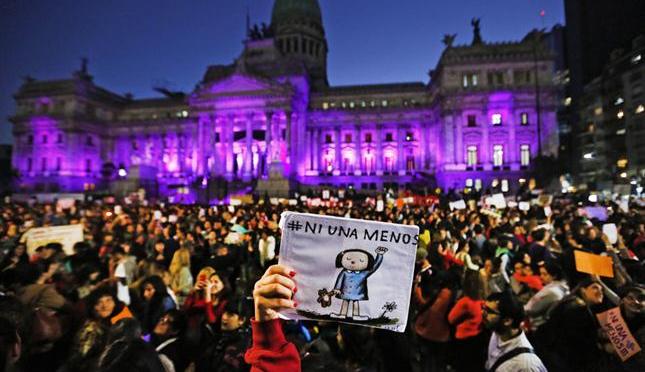
More than 150,000 gathered in Buenos Aires to protest femicide and other violence against women under the campaign #NiUnaMenos.
  • Celebrities, journalists, and politicians joined the massive crowd gathered outside Argentina’s Congress.
  • Readings and storytelling gave voice to the suffering of many women in a country that has seen gender-based violence on the increase over the last decade.
  • Similar demonstrations were held in neighboring Uruguay and Chile.

“Un grito colectivo que no cesó en la plaza y siguió retumbando en las calles…Un grito colectivo que se charlará en las casas y volverá a las redes sociales para que el tema no se apague hasta que el basta sea una realidad.”

Translation: “A collective cry that didn’t cease in the plaza and kept resounding in the streets…A collective cry that will be chatted about in homes and will go back to social media so that the point does not fade until ‘enough’ is a reality.”

More on this story at La Nación (in Spanish).

(Image Credit: La Nación)

Brazil accepts nearly 2,000 Syrian refugees, the second most in the Americas.
  • Brazil adopted measures to ease refugee entry nearly two years ago, according to its National Committee for Refugees.
  • Families find their livelihoods wiped away upon arrival, though NGOs and beneficence organizations help ease the transition through informal markets and language and professional courses.

“It was very difficult to leave our country, mostly because of our tradition…We chose Brazil because we heard that there is no prejudice here. It is a wonderful land that has received us very well.”

More on this Associated Press story at ABC News.

With girls accounting for 70% of Argentina’s 6000+ missing children cases, communities search for remedies. More from La Nación.

Argentina still struggling with femicide in a region that sees the highest rates of gender-based capital violence in the world.
More from GlobalPost.