Tag Archives: Land/Housing/Environmental Justice

U.S. Feature | Black

The Precarity of Black Urban Farming in Detroit

“If we want a stake in the process of controlling our own life, we’ve got to own land. If we are to create a society that values black life, we cannot ignore the role of food and land.”

With de-urbanization over the last few decades having freed up tracts of land both large and small, Detroit would seem to be prime real estate for local urban farmers, a rare chance to bring significant agriculture to a mid-sized American city. Given Detroit’s predominantly black population, it would also appear to be a golden opportunity to reconnect urban African Americans with their agricultural history. Urbanization, proprietary exclusion, and cultural shame from centuries of forced and coerced labor have contributed to a widening gap between African Americans and agriculture. Black land ownership, one of the few historical forms of intergenerational black wealth, has decreased dramatically over the last century, from 20 million acres in 1910 to 8 million today. The situation in Detroit, which opens access to farming without ownership, doesn’t look posed to fix that.

Public Radio International features the stories of the black urban farmers of Detroit facing difficult odds as the city hoards land titles and wealthy outside speculators buy up the remaining deeds in controversial deals that further marginalize Detroit natives.

Read more:
Black farmers in Detroit are growing their own food. But they’re having trouble owning the land.” (Public Radio International)

Additional:
D-Town Farm
Keep Growing Detroit
Earthworks Urban Farm
7 Urban Farmers You Should Know” (The Root)
Black Farmers to buy from instead of Whole Foods” (Blavity)

(Image Credit: Cybelle Codish/PRI)
Ethiopia News | Oromo

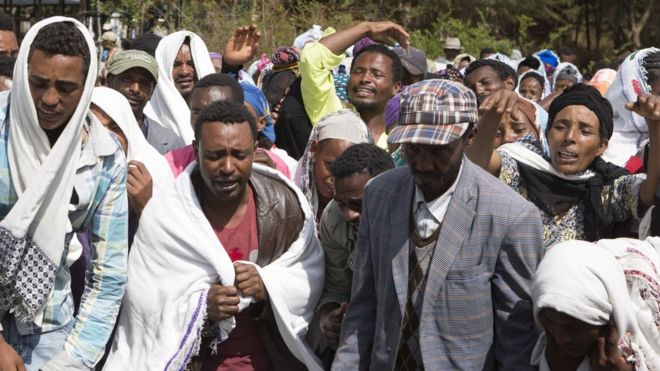
Oromo Ethiopians clash with government over land, language rights
  • Members of the ethnic community have been protesting in a cycle of dissent and retribution since November, with activists reporting as many as 200 dead despite largely peaceful demonstrations.
  • The Oromo have clashed with the government over land rights as they have found themselves pushed off their land by ongoing urban development driven by the country’s economic boom.
  • Language rights have been a particular flashpoint, with the government’s refusal to officially recognize Oromo, the country’s most widely spoken native language, leading to Amharic-only instruction in schools.

Read more:
Video: Anger among Ethiopia’s Oromo ethnic group boils over” (France 24)
What do Oromo protests mean for Ethiopian unity?” (BBC)
Ethiopian students demand end to police crackdowns in rare protest” (Reuters)

(Image Credit: via BBC)

India Feature | Women

The Women Enforcers of Ghunduribadi

While international media attention often focuses on oppressive conditions women face in India’s tribal regions, women from Ghunduribadi, in the eastern state of Odisha, have stepped up as the security forces to protect the land rights of their villages. Land rights reforms have sought to reclaim ancestral lands expropriated under British colonial laws, but enforcement has been spotty and, according to some advocates and lawmakers, diluted. As their community suffered from illegal incursions into the forest their village relies on for food and supplies, the women banded together to conduct patrols, stepping in where the law wouldn’t to ensure that their land and community are protected.

Read more:
These Indian women said they could protect their local forests better than the men in their village. The men agreed.” (Public Radio International)

Additional reading:
‘Centre, states undermining tribal rights’” (Hindustan Times)
Cong. protests ‘dilution’ of Forest Rights Act” (The Hindu)

(Image Credit: Sam Eaton/PRI)

Brazil News | Indigenous Peoples

Study shows 90% of indigenous peoples in Amazonian Brazil suffering from mercury poisoning
  • Illegal gold mining in northern Brazil has contaminated the water and food sources of at least 19 different Yanomami and Yekuana communities along with Nahua tribes in Peru.
  • In addition to the rise of illegal mining over the last three decades, uncontacted Yanomami communities have faced environmental crises and decades-old controversies over the status of their blood used for genetic testing by American anthropologists.
  • The study was a joint project of Brazilian health foundation Fiocruz, the Hutukara Yanomami Association, the Yekuana Association, and Brazilian NGO Socio-Environmental Institute.

Read more:
Mercury poisoning of Amazon Indians: alarming new statistics revealed” (Survival)
90% of Indigenous in Brazil’s Amazon Suffer Mercury Poisoning” (teleSUR English)
Indigenous tribe’s blood returned to Brazil after decades” (BBC)

(Image Credit: Fiona Watson/Survival)

South Africa Feature | Cape Malay

Bo-Kaap and Post-Apartheid Gentrification

A once exclusively and now predominantly Cape Malay neighborhood in Cape Town, Bo-Kaap has become an attractive site for South Africans and foreigners of all backgrounds looking for cheaper residential alternatives in Cape Town’s revitalized downtown. While the neighborhood survived the apartheid-era banishment of non-white South Africans from the city, it now faces an identity crisis as gentrification encroaches upon the cultural integrity of the area, including religious life and property ownership. The New York Times reports on the history of the neighborhood and residents’ attitudes towards changes over the last two decades.

Read more:
Muslim Enclave Forged in Apartheid Now Faces Gentrification” (The New York Times)

Sweden News | Indigenous Peoples

Judge rules in favor of exclusive land rights for indigenous group in northern Sweden
  • A district court ruled that the Sami, an ethnic group indigenous to northern Scandanavia and northwest Russia, should have exclusive rights to control hunting and fishing in the Arctic village of Girjas.
  • The legal battle began in the early 1990s, when the Swedish government stripped land rights to the village from the Sami, Sweden’s only officially recognized indigenous group who trace their lineage in the region back thousands of years.
  • The victory comes as the Church of Sweden has released a two-volume report detailing the history of its treatment of the Sami, including the segregated schools it ran for from the 1910s to the 1960s.

Read more:
Sweden’s indigenous Sami people win rights battle against state” (The Guardian)
Sami minority wins symbolic court victory over Sweden” (The Local)
Swedish church admits it ran ‘racist’ Sami schools” (The Local)

(Image Credit: Alamy/The Guardian)

China Feature | The Homeless

The “McRefugees” of China

“If you don’t have money, you can barely sleep.”

China’s homeless have begun turning one of the most recognizable beacons of global American corporatism for a bit of shut-eye: McDonald’s. With more than a thousand of the restaurants in mainland China open 24 hours a day, it has become a haven for the homeless in a country that severely restricts shelter residency. The New York Times profiles a few of those who make the nightly trek to the golden arches.

Read more:
China’s Homeless Find Shelter Under McDonald’s Golden Arches” (The New York Times)

Additional reading:
1,400 homeless sleeping on Hong Kong’s streets, double government estimates” (South China Morning Post)
Down and Out in China” (Radio Free Asia)

(Image Credit: Lam Yik Fei/The New York Times)

France Feature | Working Class, Immigrants & Racial Minorities

Estates of Emergency

France’s notorious housing estates–akin to housing projects in the U.S.–have long existed as symbols of an unintegrated France. Though President François Hollande has pledged to address the long-standing segregation that divides Paris’s poor banlieues from its more affluent city center, rampant unemployment, limited educational opportunities, crime, and stigmatization continue largely unchecked. The Guardian reflects on conditions in Paris’s most notorious estates a decade after riots forced what one banlieue mayor has called “social and territorial apartheid” into the national consciousness.

Read more:
‘Nothing’s changed’: 10 years after French riots, banlieues remain in crisis” (The Guardian)

(Image Credit: Ed Alcock/The Guardian)

Canada News | Indigenous

First Nations leaders take on Big Oil over massive proposed pipeline in Canada
  • First Nations leaders have joined environmental activists in opposing the proposed Northern Gateway, a 731-mile tar sands pipeline stretching from central Alberta to the British Columbian coast.
  • The pipeline has become a political battleground as PM Stephen Harper has vowed to make Canada an “energy superpower,” while Alberta’s premier has been enlisted by pipeline company Enbridge to negotiate with First Nations leaders.
  • Eight First Nations have taken the issue to court in what became the longest case heard before Canada’s federal court of appeals, claiming a faulty approval process, negligent environmental impact studies, and encroachment on First Nations’ rights.

Read more:
Indigenous Canadians take leading role in battle against tar sands pipeline” (The Guardian)
First Nations’ challenges of Northern Gateway pipeline to be heard in court” (The Globe and Mail)
Northern Gateway pipeline battle could set tone for future government, aboriginal relations” (The Canadian Press via The Vancouver Sun)

(Image Credit: Jonathan Hayward/The Canadian Press, via The Vancouver Sun)

Sweden News | Black Swedes

UN report finds increasing “Afrophobia” and discrimination against African-Swedes
  • A new UN report countered Sweden’s diversity-friendly image with data on discrimination faced by African-Swedes, who make up 2% of Sweden’s 9.6 million people.
  • In addition to discrimination in housing and employment, a national crime study found that hate crimes against people of African descent increased by more than 40% between 2008 and 2014, with a fifth of last year’s incidents involving violence.
  • Sweden has come under fire for several measures anti-racism advocates argue undermine their work, including removing the word “race” from the country’s Discrimination Act and the country’s failure to own up to its role in the transatlantic slave trade.

Read more:
Sweden’s liberal reputation tarnished as race attacks rise” (The Guardian)
Sweden’s liberal image is a mirage that hides a very ugly problem” (Quartz)
Afrophobic hate crimes on the rise in Sweden” (The Local)

(Image Credit: Anders Wiklund/AFP/Getty Images, via The Guardian)

Afghanistan Feature | Sikhs & Hindus

The Sikhs and Hindus of Afghanistan

Afghanistan has seen millions uprooted as local communities have found themselves caught in the middle of the conflict between the Taliban and a coalition of Afghan and U.S. forces. After the Taliban took control of the country in the mid-1990s, two of the country’s religious minorities–Hindus and Sikhs–saw their insecurity skyrocket, with land seizures, open harassment, and economic exclusion causing most of the tens of thousands in their ranks to flee for asylum elsewhere. Anadolu Agency, a state-run media outlet in Turkey, provides a glimpse of the outlook Afghan Hindus and Sikhs have on their prospects today.

Read more:
Afghan Sikhs, Hindus fear violence but long for home” (Anadolu Agency)

Other coverage:
Feeling alienated, Sikhs choose to leave Afghanistan” (The Hindu)
Oppressed by Taliban, Afghan Sikh families seek help from DSGMC” (The Times of India)
Facing Intolerance, Many Sikhs and Hindus Leave Afghanistan” (Wall Street Journal)

(Image Credit: via Anadolu Agency)

Australia News | Seniors & People with Disabilities

New housing development in New South Wales looks to ease later-in-life care for people with disabilities with aging caretakers
  • The Pathways Project is a development providing housing units for people with disabilities and their aging family caretakers in a specially designed community.
  • The development allows families to continue to choose their disability services independently through the National Disability Insurance Scheme.
  • Ground broke on the project in February and is set to be completed by November, with its first residents by the end of the year.

“We really want to share what we’re doing because if it means there will be more accommodation for people who are ageing with a disability then that’s a wonderful thing.”

Read the full story at Australian Ageing Agenda.

(Image Credit: The Pathways Project, via Australian Ageing Agenda)