Caught between the Western-democratic values of the EU and conservative nationalists and Kremlin supporters, Latvia has seen a surge in so-called family values activism in recent years. Activists have increasingly targeted LGBT rights and visibility as symptoms of cultural decline, and anti-LGBT sentiment has been connected to wide-ranging issues including the rights of Latvia’s Russian minority, abortion, corporal punishment, and academic freedom. EurasiaNet investigates how groups like Asociācija Ģimene (Family), Mūsu bērnu (Our Children), Dzimta (Kin), and Sargāsim mūsu bērnus! (Let’s Protect Our Children!) have grown their reactionary causes, including the influence of Russia’s hard-line anti-gay, “pro-family” campaign next door.
Malaysian film banned for LGBT and government-mocking storylines
Banglasia, directed by Malaysian YouTube star Namewee, was banned by the government for “mocking national security issues” and highlighting “negative sociocultural lifestyles such as lesbian gay bisexual transgender (LGBT).”
The film focuses on a diverse group of people overcoming their differences and took comedic aim at controversial political events from Malaysia’s history.
A Kickstarter campaign to recoup lost finances and secure an Internet release for the film stalled.
Far-right protesters in Ukraine attack LGBT festival attendees after officials ban event
Police and city officials in Lviv refused to give official permit to the equality-themed event, whose program included film screenings, literary discussions, and a public march.
After a last-minute court hearing banned the festival’s public events, far-right protesters descended on the hotel housing festival attendees, throwing stones and allegedly shouting “kill, kill, kill” as attendees were evacuated.
Although Lviv’s mayor admonished both victims and attackers, Ukraine’s Minister of Foreign Affairs condemned the attack and announced police had begun an investigation.
Sun Wenlin and Hu Mingliang have sued a civil affairs bureau for rejecting their attempt to register for marriage.
The case, the first challenge to China’s ban on same-sex marriage, was set to take place last month, although postponements and China’s notoriously opaque media climate have impeded word of the case’s outcome.
Following the decriminalization of homosexuality in 1997 and its official depathologization in 2001, a small but increasingly visible LGBT community has begun to emerge in China’s urban areas, despite attempts to crackdown on media visibility.
In an effort to highlight geographically diverse conditions for minorities and underrepresented communities, Outlas is gathering and featuring publicly available personal accounts, documentaries, features, and other video content centering the experiences of marginalized communities around the world. Join us at the Outlas YouTube channel, where two playlist series highlight diverse stories from across the platform:
Intersections Featuring the experiences of multiple minorities and the effects and subcultures of compounded marginality, from Muslim women to queer people with disabilities
Contexts Featuring regionally specific content highlighting how geopolitical contexts shape identity from place to place, including people of African descent in East Asia, atheists in Africa, and beyond
The first Intersections playlist is an evolving collection devoted to the experiences of queer seniors. Queer seniors face a range of community-specific vulnerabilities, from housing and services discrimination to ageism in the broader LGBT community. As the generations that survived the AIDS epidemic that eviscerated their ranks grow older, they age into physical, psychological, and financial health issues that disproportionately impact LGBT elders. But attention to vulnerability alone fails to highlight the vibrant cultures and histories of queer elders. Videos in the collection also tackle sexuality and aging, advice for younger generations, and the tremendous historical memory that queer seniors hold in need of preservation.
Featured content comes from countries including the U.S., Canada, the U.K., and Australia and includes the stories of queer women, people of color, drag performers, and transgender individuals. Unfortunately, the limited geographic scope of available content is a reminder that many if not most queer seniors around the world remain in the closet, located in regions unfriendly or even inhospitable to their visibility. We will continue to add more dynamic stories of queer seniors (particularly from non-English-speaking parts of the world) where appropriate and available. Outlas is always open to suggestions!
View the full playlist on YouTube and stay tuned for more collections featuring the experiences of other underrepresented groups around the world.
Chinese broadcasting regulator releases guidelines banning LGBT depictions
China’s top broadcasting regulator and an industry trade group released the guidelines, which, though not technically law, have appeared as authorities have censored and removed LGBT-friendly online and offline programming.
The guidelines forbid the depiction of “abnormal sexual relationships and behaviors,” which include “incest, same-sex relationships, sexual perversion, sexual assault, sexual abuse, sexual violence, and so on.”
Diverse representation has been further inhibited by China’s recent ban on foreign-owned media operators from publishing online content in the country.
Countries around the world are increasingly acknowledging the extreme physical and psychological effects of LGBT “conversion” or “reparative therapy,” pseudoscientific practices including electroshock therapy, sexual violence, and psychological assault run in an effort to purge LGBT individuals of their sexual and gender orientations and identities. From East Asia to the Americas to the Middle East, governments have begun banning such practices, though they continue to run to the financial and psychological detriment of their subjects. The Guardian examines global stories and efforts to dismantle the phenomenon.
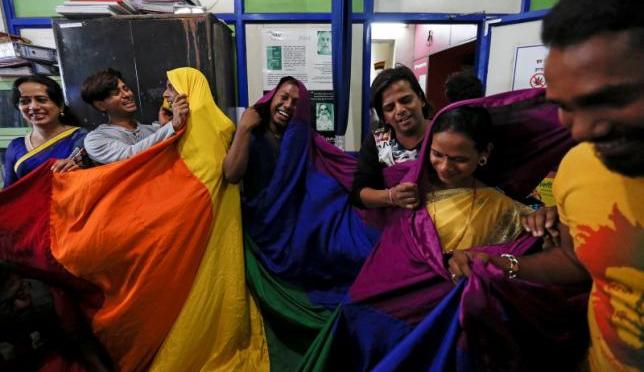
India’s top court to reconsider law criminalizing homosexual sex
The court announced it will review the constitutionality of the law following a five-judge panel to review the 1860 law, reinstated in 2013 after a four-year reprieve.
Homosexual acts carry a 10-year prison sentence, and though rarely enforced, the law can be used to coerce and intimidate individuals in a country where 75% of the population continues to express disapproval of homosexuality.
Should the court uphold the law, advocates would have to depend on future reform to come from the country’s largely conservative parliament.
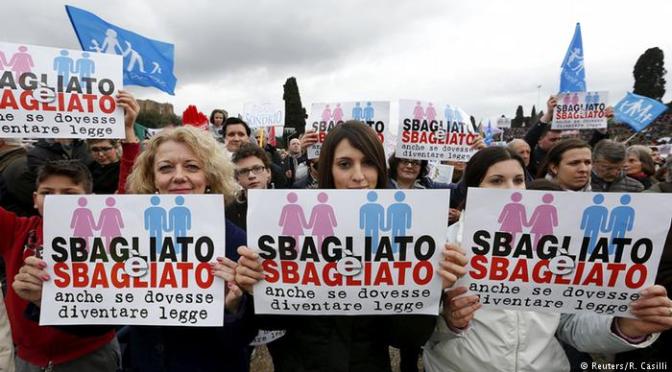
Thousands protest same-sex civil union legislation under review in Italian parliament
The protesters, estimated in size from the tens of thousands to the millions, gathered as part of Rome’s “family day,” where they expressed opposition to the legislation currently under examination by the Italian senate.
A similar protest in 2007 contributed to the withdrawal of a civil union proposal, but PM Matteo Renzi anticipates the legislation’s passage this time.
Italy remains the only holdout among the major Western powers in granting same-sex couples the right to legal partnership or joint adoption, with polls indicating around 70% of the country in support of partnership rights and 24% in support of adoption rights.
Indonesian city orders Muslim hardliners to remove anti-gay banners
Bandung, Indonesia’s third-largest city, ordered the Islamic Defenders Front (FPI) to take down banners and encouraged them to leave.
The FPI targeted boarding houses in the city they believed to be housing LGBT residents.
The pro-LGBT support comes as Indonesia’s education minister has faced a storm of criticism over anti-LGBT comments and a call to ban an LGBT research and counseling group at the University of Indonesia.
Court fines Turkey’s football governing body for firing gay referee
Istanbul’s 20th Court for Serious Crimes fined the Turkish Football Federation 23,000 Turkish lira ($7,900) for revoking the refereeing license of Halil İbrahim Dinçdağ, the country’s first openly gay referee, in 2009.
Dinçdağ’s release came after the TFF declared him unfit for military service due to the military’s exemption of gay men from military service, with which referees are required to be in good standing.
Dinçdağ’s lawyer plans to appeal the ruling, which fell considerably short of the 110,000 lira originally demanded.
Colombian high court legalizes adoption for same-sex couples
Colombia’s constitutional court ruled 6-2 in favor of opening adoption up to same-sex couples, drawing on both constitutional and international law as justification.
The Court struck down the prohibition against adoption by same-sex couples by affirming the rights of children to a family, arguing that parental gender and sexual diversity has no negative impact on a child.
The country joins regional neighbors Brazil, Argentina, and Uruguay in allowing same-sex couples to adopt.
Taiwan celebrated Pride with its 13th-annual Pride parade, Asia’s largest. Tens of thousands descended upon the streets of Taipei from around the world to celebrate LGBT individuals and culture on an island notable for its LGBT acceptance.
Ontario proposes changes to expand gender reassignment referral capacity
Ontario’s health minister announced proposals that will allow local healthcare providers to provide referral services for transgender individuals seeking gender reassignment surgery.
Currently, those seeking the surgery must be referred through the Gender Identity Clinic program at the Centre for Addiction and Mental health (CAMH) in Toronto, facing up to a two-year wait if referred.
Ontario still lacks in-province gender reassignment surgery capabilities, but the health minister indicated that the absence is currently under review.
Students lobby Portland school board for ethnic studies class
The Asian Pacific Islander Leaders for the Liberation of Youth (ALLY) have lobbied the Portland Public Schools Board of Education for the creation of at least one ethnic studies class in all 10 of the public high schools in Oregon’s largest city.
Asking that the class count towards the social studies graduation requirement, the group has called for a course that covers the contributions of Asian, Pacific Islander, African, Latino, Arab, and Native Americans and LBTQ Americans of color to American history and culture.
Students supported their curriculum-based arguments with data indicating increased academic performance, attendance, and graduation rates for students who have taken similar courses in other schools.





 Outlas