Travel bans trap Egyptian activists in “giant prison”
Two prominent human rights advocates—Aida Seif al-Dawla and Azza Soliman—recently discovered they were barred from traveling in and out of Egypt as President Abdel Fattah al-Sisi continues targeting civil society and human rights organizations.
Human rights monitors report that 217 people have been subject to travel bans between 2014 and 2016, 115 of whom are critics of the Sisi-led government.
Activists and journalists reported being met with deferral or radio silence when inquiring about the cause or origin of their bans, with the government denying a crackdown.
Mauritanian clerics push for application of death penalty for blogger convicted of apostasy
Mohamed Ould Cheikh Ould Mkhaitir was convicted in 2014 over a blog post discussing Mauritania’s racial stratification and the history of racial discrimination in Islam.
The Forum of Imams and Ulemas recently issued a fatwa calling for Mkhaitir’s execution in line with absolutist laws regarding heresy in Islam.
If carried out, Mkhaitir’s execution would be the first in the country since 1987, prompting international human rights organizations including Amnesty International and Reporters Without Borders to advocate for his pardon.
Egyptian government limiting movement rights of critics
Nearly 500 journalists, activists, and advocates have been deported from Egypt since President Abdel Fattah al-Sisi’s inauguration in 2013 for having criticized the government, according to one civil rights group.
Critics of Sisi, the judiciary, and other government powers have been subjected to travel restrictions, limiting their movement in and out of the country.
Those subject to travel bans often don’t find out about their status until at airports, with the requirement of a judicial order only infrequently being met.
African Union prepares to launch common African passport
The A.U. is preparing to launch the e-Passport, a transnational passport opening up migration between the 54 constituent countries, at its upcoming summit in Kigali, Rwanda.
The e-Passport is expected to function similar to European Union citizenship, promoting mobility and increased economic integration across the African continent.
The passport will initially be available to heads of state and other diplomatic and foreign affairs representatives, with rollout to citizens expected to take place in 2018.
At least 700 migrants and refugees die in last week along trans-Mediterranean route
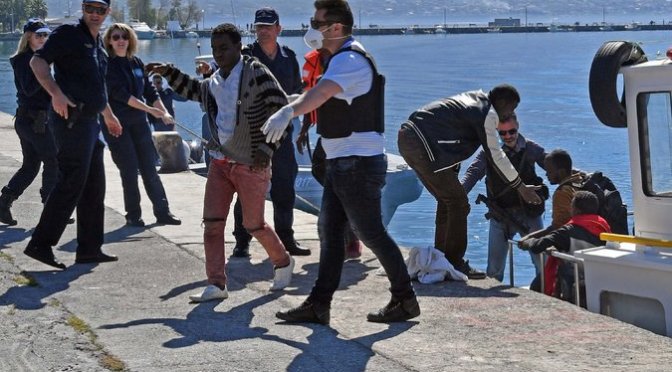
The UNHCR concluded from survivor interviews that some 550 of 670 died after a boat capsized on its way to Italy from Libya, with other scattered wrecks throughout the week leading to at least 150 other deaths.
As warmer temperatures have created more favorable travel conditions, an estimated 13-14,000 have been rescued over the last week during Italian naval operations in the Mediterranean.
The U.N. believes most of those making the trek have been sub-Saharan African migrants and refugees caught up in smuggling networks.
The International Day Against Homophobia, Transphobia & Biphobia
Commemorating the day when homosexuality was de-pathologized by the World Health Organization in 1990, the 13th-annual International Day Against Homophobia, Transphobia & Biphobia (IDAHOT) stands as an occasion for global mobilization towards LGBT visibility and security. The day, like many global celebrations, is also one many governments choose to speak out on global human rights and minority security, announcing initiatives to support their LGBT citizens and international projects.
Even today, ongoing disagreements between nations over LGBT rights have prompted diplomatic rows and roadblocks to international cooperation, including the recent objection of 51 Muslim countries to the participation of LGBT groups in a U.N. AIDS forum in June. The push to extinguish homophobia, transphobia, and biphobia at all geographic levels remains important to the global mobility of LGBT people worldwide.
LGBT Nigerians have continued wrestling with conflicting legal messages, with the recent passage of the landmark HIV Anti-Discrimination Act doing little to undo the effects of a 2014 anti-homosexuality law.
The Gay and Lesbians Association of Zimbabwe (GALZ) organized events for IDAHOT in Bulawayo, focusing on mental health as ongoing social and healthcare difficulties plague the community.
Though homosexuality remains criminalized in Tunisia, activists have achieved increased visibility and pushed for legal reform amidst ongoing discrimination.
Israel reaffirmed its commitment to LGBT Israelis, announcing funding to support an emergency shelter for LGBT youth and a hostel for trans people who have recently undergone gender confirmation surgery.
Days before IDAHOT, activists staged a sit-in outside of a Beirut gendarmerie, protesting Lebanon‘s anti-homosexuality legal holdovers from French occupation. Similarly, the Lebanese Medical Association for Sexual Health (LebMASH) issued an appeal to the Lebanese government to decriminalize same-sex relations, arguing for recognition of homosexuality’s presence within the natural variation of human sexuality.
U.S. President Barack Obama released a statement of support as his administration lended its voice to a national debate over the bathroom rights of trans people.
Across Latin America, important gains in same-sex partnership and family rights and gender identity healthcare and legal protections have heartened LGBT Latin Americans, but the region continues to have some of the highest reported rates of violence against the LGBT community in the world.
LGBT organizations held cultural and political events throughout Argentina to highlight conditions facing the Argentine LGBT community, call for an anti-discrimination law, and press for federal recognition of the International Day Against Sexual Orientation and Gender Identity Discrimination, as the day is known.
Cuba celebrated the day fresh off Pride events in Havana, where Mariela Castro, daughter of President Raúl Castro, led a parade of thousands through the city streets.
As the country continues contentious battles including the push for marriage equality and erasure of “gay panic” legal defenses, rainbow flags and celebrations appeared across Australia, including over police stations in Canberra, in the streets of Brisbane, and in the senior-care facilities of Tasmania. In Victoria, officials announced a retreat for Aboriginal gender minorities to be held later in the year.
In China, a study conducted by the U.N. Development Programme, Peking University, and the Beijing LGBT Center, the largest of its kind to date, was released revealing that only 5% of LGBTI Chinese are fully out at school and work, but also showed encouraging levels of acceptance of LGBTI people among China’s youth. The head of Hong Kong’s Equal Opportunities Commission expressed support for anti-discrimination legislation at IDAHOT festivities in the city.
In Fiji, former President Ratu Epeli Nailatikau joined festivities at the French Ambassador’s residence to celebrate the island’s LGBTQI community.
A tug-of-war over LGBT rights between Islamic fundamentalists and pro-diversity moderates in Indonesia has led to mixed messages about LGBT security in the nation, spurring anti-discrimination protests.
A recent Human Rights Watch report on anti-LGBT bullying in Japan served as a reminder of the purpose of the day, highlighting rampant anti-LGBT sentiment even as the government has initiated broad efforts to combat bullying in schools.
The divergent prospects for LGBTI people across Europe, from Western Europe’s distinctive commitment to the protection of gender diversity to ongoing persecution in the East, was further confirmed through a UNESCO report highlighting anti-LGBT violence in schools released as global education ministers met in Paris.
Rainbow colors appeared in the shopping district of Cyprus‘s capital as 22 organizations came together to organize events to launch the country’s third Pride Festival, focusing on the need to increase legal recognition of both sexual and gender minorities in the country.
In Gibraltar, organizers canceled event plans in support of action on marriage equality legislation currently under consideration, arguing that holding a rally in front of the Parliament as uncertainty prevails would undermine pressure on MPs.
Kosovo‘s first Pride march brought out hundreds from the LGBT community to Pristina, including the U.S. and U.K. ambassadors.
Organizations in Luxembourg planned a silent march to call attention to the plight of LGBTI individuals worldwide and call for increased international protections (including asylum).
Organizers in Serbia took the day to announce the date of this year’s Pride parade (September 18) and address concerns of homophobia as right-wing parliamentary representation has increased.
Advocates, allies, and diplomats gathered around the rainbow flag raised at the US Embassy in Latvia.
After advocates scrapped plans for IDAHOT activities in Georgia due to security concerns, a group of activists were arrested for painting pro-LGBT graffiti on administrative buildings. A “Family Day” protest against LGBT rights and visibility, the third such anti-LGBT demonstration, brought together members of Georgia’s conservative Orthodox community and international religious groups.
In the U.K., London’s new mayor promised to make the city a more just place for its LGBT residents as a rainbow flag flew over the Mayor’s Office.
Like the color it purports to name, the social label black absorbs, integrates, and obscures distinct but interrelated phenomena: a skin tone of context-dependent shade, a racial classification from bygone times, an ethnic designation, a class marker, an immigration status, an ancestry, a cultural heritage, and an index of historical wrongs still fresh in memory. Black has often served as shorthand for of African descent, but perhaps nowhere most complicates that substitution than a region on the continent itself: North Africa. Continue reading Citations: Black in North Africa→
As many as 500 may have died in migrant boat sinking in Mediterranean
The U.N. refugee agency indicated as many as 500 may have died after a boat carrying mostly African migrants and refugees capsized between Libya and Italy, according to interviews with 41 survivors.
If verified, the incident would be the largest migrant tragedy on record since the April 2015 sinking that killed more than 800 migrants.
Smugglers have returned to dangerous trans-Mediterranean routes between Libya and Italy following a recent deal between the E.U. and Turkey to stem migration in the eastern Mediterranean.
Italian student found dead in Cairo after writing article critical of government
Giulio Regeni, a 28-year-old graduate student at the University of Cambridge, was found dead alongside a road outside Cairo with cigarette burns and other signs of torture on his body.
Regeni had been conducting research on Egyptian labor rights and had written an article criticizing the Egyptian government’s anti-union stance and lack of press freedom for Il Manifesto, a left-wing newspaper in Rome,.
Italy summoned its Egyptian ambassador to discuss the situation, requesting a joint investigation to determine the cause of the student’s murder, which Egyptian authorities have ruled an accident.
January sees record number of migrant deaths in eastern Mediterranean
To date, there have been 218 deaths as migrants have crossed the Aegean Sea to reach Greek shores, a number not reached until mid-September in 2015.
The spike in deaths comes as the overall number of migrants and refugees attempting to reach Europe has reached its lowest point since June 2015.
The migration shift occurs as a changing of the guard has taken place among people-smugglers in North Africa, with the brief calm in traffic from Libya having recently given way to a fresh, more lethal round.
More than a dozen Sudanese refugees killed by Egyptian security forces
At least 15 Sudanese refugees were killed and eight wounded attempting to enter Israel from the Sinai peninsula.
Egyptian officials first said the refugees were shot attempting to reach the southern border of Israel, but later revised their account to say they were caught in the crossfire between security forces and smugglers.
The incident is one of the most violent involving Sudanese refugees since 2005 and comes as the refugees face crackdowns by Egyptian police, exploitation and abuse by smugglers, and detention and deportation in Israel.
Moroccan professor faces charges for government criticism as hunger strike ends
Maati Monjib, a writer and professor of political history and African studies, is charged with receiving foreign funds with the intent of undermining Moroccan institutions and national security.
Monjib ended his hunger strike after the government lifted the travel ban placed on him, though he has indicated that he will resume should government harassment continue.
Monjib faces up to five years in prison for his work with the Ibn Rochd (Averroes) Institute and the Moroccan Association of Investigative Journalism (AMJI), which received funding from Netherlands-based human rights organizations.
Egypt muzzles journalists during investigation of killing of Mexican tourists
Eight Mexican tourists and their Egyptian guides were killed by Egyptian security forces after allegedly being mistaken for insurgents.
International and domestic journalists have been banned from covering the investigation into the incident, leading to criticisms of a lack of transparency.
Human rights organizations have condemned Egypt’s military operations in the Western Sahara and Sinai Peninsula, arguing that civilian deaths have been endemic.
“Usually when there is such a ban on publication it has do with very tough cases where one could find evidence or embarrassing information about the involvement of some government high officials or military strongmen.”
Egyptian student pursues legal action after alleging her exam results were falsified
Mariam Malak, a high-achieving student, took action and demanded an independent inquiry after seeing that the handwriting on the test did not match her own.
Malak, who scored 97% on the test in the previous two years, has aspirations of becoming a doctor.
With suspicions that Malak’s results may have been switched with another student’s, the case has become a symbol of corruption in the Egyptian education system.





 Outlas